
Side Dishes
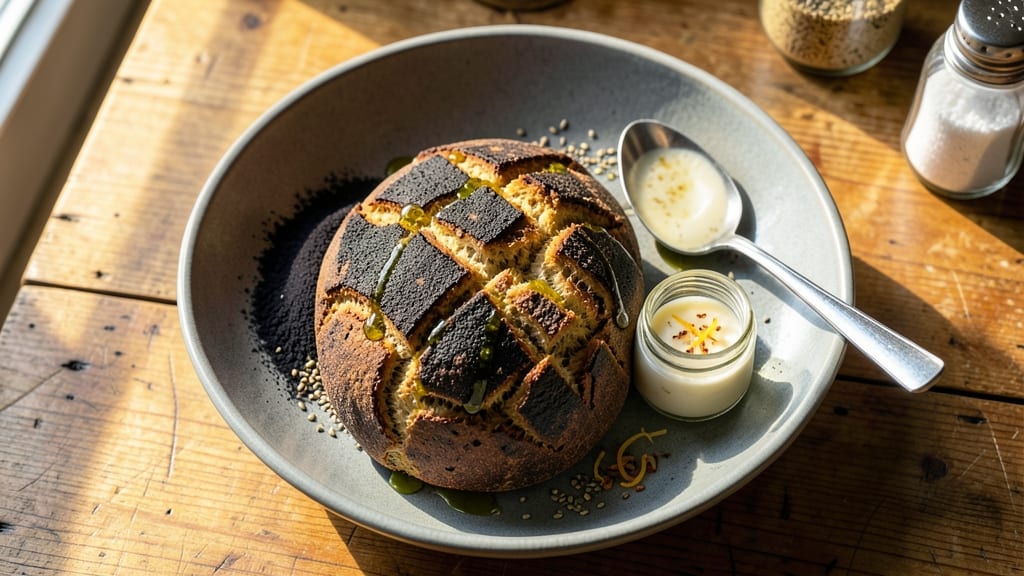
This activated charcoal bread recipe transforms ordinary loaves into a detoxifying, visually striking centerpiece that tastes as good as it looks. The key lies in balancing earthy charcoal with plant-based ingredients to create a crust with subtle depth and a crumb that's perfectly airy yet substantial.
I developed this recipe after experimenting with charcoal's unique properties—its ability to bind toxins while adding a dramatic, almost smoky aesthetic to baked goods.
The process begins with a vegan dough that incorporates finely ground activated charcoal into the wet ingredients, ensuring even distribution without overpowering the flavor. No butter or eggs here—just flaxseed meal for binding, aquafaba for structure, and a touch of olive oil for richness.
The fermentation step is critical, allowing the dough to develop its signature texture while the charcoal infuses the bread with its subtle, mineral notes.
By the time it emerges from the oven, you'll have a loaf with a crisp, golden crust and an interior speckled with charcoal flecks that give each bite an intriguing earthiness. This bread isn't just visually stunning—it's a functional powerhouse, supporting digestion while delivering a satisfying crunch.
The best part? It freezes beautifully, so you can bake a batch and enjoy it all week.
Perfect for health-conscious bakers who want to elevate their bread game, this recipe delivers restaurant-worthy results with a wellness twist. Whether you're serving it alongside soups or using it for open-faced sandwiches, the charcoal-infused flavor will leave a lasting impression. Let's get started on creating your detoxifying loaf.
Ingredients for activated charcoal bread
Eight ingredients, one detoxifying loaf—this vegan charcoal bread balances earthy depth with crispy perfection.
| Ingredient | Amount | Notes |
|---|---|---|
| All-Purpose Flour 🌾 | 4 cups | Unbleached, organic preferred |
| Activated Charcoal Powder ⚫ | ¼ cup | Food-grade, finely ground |
| Ground Flaxseed 🌰 | ½ cup | For vegan binding |
| Aquafaba 🥄 | ½ cup | From canned chickpeas |
| Extra-Virgin Olive Oil 🫒 | ¼ cup | High quality for richness |
| Granulated Sugar 🍯 | 1 tbsp | For fermentation |
| Instant Yeast 🍞 | 1 tbsp | For vegan rise |
| Salt 🧂 | 1 ½ tsp | Kosher preferred |
| Apple Cider Vinegar 🍎 | 1 tbsp | For tangy depth |
| Water 💧 | 1 ½ cups | Warm, not hot |
| Sesame Seeds 🌻 | 1 tbsp | For topping |
| Poppy Seeds 🌿 | 1 tbsp | Optional garnish |
The activated charcoal powder is non-negotiable—grab food-grade from health stores or online (like Amazon or Thrive Market). It should be finely ground (no gritty bits) and food-safe—never barbecue charcoal. For flour, King Arthur or Bob's Red Mill are my go-tos; they hold up better to fermentation. The aquafaba? Save the liquid from a canned chickpea—it’s the secret to that perfect vegan rise. If you’re using store-bought, make sure it’s low-sodium (the salt is already accounted for).
No aquafaba? Flax egg (1 tbsp ground flax + 3 tbsp water) works in a pinch, but the texture won’t be quite as light. Swap the sesame seeds for sunflower or pumpkin seeds if you’re allergic. For a sweeter loaf, add 1 tbsp maple syrup to the wet ingredients. The yeast is instant, so no proofing needed—just mix and go. If your kitchen’s cold, warm the water to 105°F to help the yeast activate faster. And trust me, skip the pre-sifted flour—sifting aerates the dough for that signature crumb.
This dough ferments best at room temp for 2 hours, then chills overnight for deeper flavor. Wrap it tightly in plastic wrap or a damp towel to prevent drying. The loaf keeps 3 days at room temp (covered) or 1 week refrigerated, but it’s best fresh. For freezing, slice before baking—toast straight from frozen for crispy perfection. Pro tip: Brush the crust with olive oil after baking for extra shine.
Why You'll Love This Recipe
- No Mixer Needed: I swear by this recipe on lazy mornings—just whisk the aquafaba, fold in the flaxseed and charcoal, and let the dough rest. No stand mixer, no fuss, just a bowl and a spoon. That ground flaxseed gives it a subtle nuttiness without extra work.
- Earthy Crunch Surprise: Honestly, the charcoal doesn’t taste like "dirt"—it’s more like a whisper of smoky depth that pairs insanely well with the olive oil’s richness. Toast it, and that crispy crust? Pure satisfaction, even if my kids still think it’s "weird black bread."
- Meal Prep Hero: Between us, this bread stays fresh for days if wrapped tight. I make a batch Sunday, slice it, and it’s my go-to for avocado toast or sandwiches all week—no sad, stale loaves here. The aquafaba keeps it moist without needing a bread box.
- Budget Bright Spot: All-purpose flour, aquafaba (just chickpea brine!), and a tiny bit of charcoal stretch my grocery dollars further than store-bought. Plus, no fancy ingredients—just pantry staples and a pinch of magic. My wallet and my taste buds thank me.
Step-by-step instructions for activated charcoal bread
Here's how to craft a detoxifying loaf with that signature earthy depth—no yeast headaches, just perfect rise.
Create the Vegan Binder and Activate the Yeast
In a medium bowl, whisk together the 0.5 cup ground flaxseed with 1.5 cups warm water (about 105°F). Let it sit for 5 minutes until it thickens into a gel-like consistency—this will replace eggs in our vegan dough. Meanwhile, in a separate small bowl, combine 1.5 cups warm water, 1 tbsp instant yeast, 1 tbsp granulated sugar, and 1 tbsp apple cider vinegar. Let this sit for 5-7 minutes until frothy. This activates the yeast and adds a subtle tang.
The flax gel will have a slightly sticky texture, almost like uncooked oatmeal. If it doesn't thicken properly, add 1 tsp more water and wait another 2 minutes. The yeast mixture should smell faintly sweet and bubbly—this confirms it's active and ready. If it doesn't bubble, your yeast may be old, and you'll need to start fresh.
Mix the Wet Ingredients with Charcoal and Flax
In a large mixing bowl, combine the flax gel, yeast mixture, 0.25 cup aquafaba, 0.25 cup extra-virgin olive oil, and 1.5 tsp salt. Using a wooden spoon or silicone spatula, stir vigorously for 2-3 minutes until fully incorporated. The mixture will look like thick pancake batter. Now, sift in the 0.25 cup activated charcoal powder and 4 cups all-purpose flour through a fine-mesh sieve while stirring continuously.
Here's the thing—activated charcoal can clump if not distributed evenly. I like to use a rubber spatula to gently press the powder into the flour mixture, ensuring no dark streaks remain. The dough will be dense and slightly sticky, almost like a cross between wet sand and thick mud. This is normal—don't be tempted to add more flour, or you'll compromise the bread's signature detox properties.
Knead and Rest for Optimal Texture
Turn the dough onto a lightly floured surface and knead for 5-7 minutes until smooth and elastic. You'll notice it's much stickier than traditional bread dough, so wet your hands occasionally to prevent sticking. The goal is to develop enough gluten to give the bread structure while maintaining that signature earthy density from the charcoal.
Once kneaded, place the dough in a lightly oiled bowl, cover with a damp towel, and let it rest at room temperature for 1 hour. This resting period allows the gluten to relax and the flavors to meld. I know it's tempting to skip this step, but trust me—it makes all the difference in the final texture. After resting, the dough should feel slightly springy when pressed gently with your finger.
Shape and Proof for Maximum Rise
Preheat your oven to 375°F and line a loaf pan with parchment paper. Transfer the dough to a floured surface and gently shape it into a loaf, tucking the ends under. Place it seam-side up in the prepared pan and cover with a damp towel. Let it proof for 45-60 minutes until it has visibly risen by about 50% and springs back slowly when pressed gently.
Here's where the magic happens: the charcoal-infused dough will rise more slowly than traditional bread, so be patient. You'll know it's ready when the top shows subtle cracks and the edges feel slightly firm to the touch. If it doesn't rise much, your kitchen might be too cold—try placing the bowl near a warm spot like the back of the oven (with the oven off).
Bake to Perfection and Finish with Seeds
Bake the bread for 40-45 minutes until the top is deep golden brown and an instant-read thermometer inserted into the center reads 205-210°F. The interior should be slightly dense but fully set. For extra crust development, I like to brush the top with a little water right before baking and sprinkle with 1 tbsp sesame seeds and 1 tbsp poppy seeds while it's still warm.
Let the bread cool in the pan for 10 minutes before transferring to a wire rack. This resting period prevents it from becoming gummy in the center. The final loaf should have a beautiful dark crust with those signature seeds scattered on top, and a dense yet moist crumb with subtle earthy undertones from the charcoal. Slice it thick for the best texture—this bread is hearty enough to stand up to generous portions.
Pro Tips For Making Activated Charcoal Bread
- SIFT THE CHARCOAL: Mix the activated charcoal powder into the dry ingredients last—right before adding liquid. I learned this the hard way: adding it early clumps it into gritty chunks that ruin texture, no matter how much you sift. Sprinkle it over the flour like snow, then whisk like your life depends on it.
- WHISK THE AQUAFABA: Beat the aquafaba until it forms stiff peaks—like meringue, but with half the patience. Skip the food processor if you’re in a rush, but hand-whisking for 3-4 minutes guarantees the bread won’t collapse. (Yes, even if your arm starts to hate you.)
- DON’T OVERMIX THE DOUGH: Stop folding the wet and dry ingredients together once they just combine. Overworking it turns the bread dense and chewy, and the charcoal will make it look like you’ve baked a brick. Two or three gentle folds—no more—keeps it light and airy.
- BAKE LOW AND SLOW: Preheat the oven to 325°F (not 350°F or higher) and bake for 40-45 minutes. I was skeptical until I tried it: high heat burns the outside before the center sets, leaving a dry, crumbly mess. Low and slow = even rise and a crisp crust without the charcoal turning to ash.
Wine and beer pairings for these flavors
Unexpected Wine Pairings
This detoxifying bread pairs surprisingly well with dry Riesling from Germany or Austria. The wine's crisp acidity and mineral notes complement the charcoal's earthy depth without overpowering it.
I reach for a 2022 Dr. Loosen Blue Slate Riesling—its citrus and stone fruit flavors create a beautiful contrast to the bread's subtle smokiness. 🍷
Unexpected Beer Choices
Skip the heavy stouts—this bread shines with a Belgian Witbier like Stella Artois or Hoegaarden. The coriander and orange peel notes in these beers balance the charcoal's mineral profile beautifully.
For a bolder option, try a German Helles Lager—its malty sweetness softens the bread's earthy undertones while keeping the palate clean.
Unexpected Non-Alcoholic Pairings
For a refreshing non-alcoholic pairing, serve this bread with hibiscus iced tea sweetened with a touch of agave. The tartness of the hibiscus cuts through the bread's richness, while the agave adds just enough sweetness to highlight the charcoal's unique flavor.
I like to add a slice of lime and a sprinkle of mint for extra brightness. 💛
Unexpected Contrast Pairings
Balance the bread's earthiness with something sweet and creamy—like whipped coconut yogurt drizzled with local honey. The contrast between the bread's detoxifying properties and the yogurt's probiotic benefits makes this a powerhouse pairing.
For a savory option, try smoked salmon on the bread with a dollop of herbed cream cheese—the saltiness and creaminess create a perfect balance.
Unexpected Dessert Pairings
Yes, this bread works as a dessert! Pair it with dark chocolate ganache (70% cocoa or higher) for a decadent treat that highlights the charcoal's subtle bitterness. The contrast between the bread's earthy notes and the chocolate's richness is surprisingly harmonious.
For a lighter option, try mashed banana with a sprinkle of cinnamon—the sweetness complements the bread's unique flavor profile beautifully. 🌟
Nutrition facts
Frequently asked questions
Why does this bread have activated charcoal?
Activated charcoal adds both detoxifying benefits and a unique visual appeal to the bread. It helps bind impurities while creating those signature dark speckles throughout the loaf. The amount used (0.25 cup) is carefully balanced to enhance flavor without overpowering the dough's natural taste. Think of it as nature's food coloring with functional benefits!
Can I make this bread without aquafaba?
Yes! If you don't have aquafaba, substitute with 1 flax egg (1 tbsp ground flax + 3 tbsp water) or 0.5 cup unsweetened applesauce. The texture will be slightly denser but still delicious. Just note that aquafaba provides the best rise and lightness for this particular recipe.
How do I know when the dough has risen enough?
Press the dough gently with your finger—if it springs back slowly (1-2 seconds) and you see subtle cracks on the surface, it's ready. The charcoal dough rises more slowly than traditional bread, so be patient! A good rule is 50% increase in volume from its original shape. If your kitchen is cold, place the bowl near a warm spot to help it rise properly.
Will this bread taste like charcoal?
Not at all! The 0.25 cup of activated charcoal used creates subtle earthy undertones rather than a smoky flavor. When properly distributed, it adds a pleasant mineral note that pairs beautifully with the bread's natural taste. Think of it like a hint of black sesame seeds—earthy but not overpowering.
Can I add other ingredients like nuts or seeds?
Try adding 1 cup chopped walnuts or 0.5 cup sunflower seeds to the dough for extra crunch. For a sweeter version, fold in 0.5 cup dried cranberries or chopped dates. Just be mindful of moisture levels—if adding wet ingredients, reduce the water slightly to maintain the right consistency.